 简体中文
简体中文 English
 русский
 Español
Fubang is a professional manufacturer specializing in the design, production and sales of stainless steel chains.
Our A series short pitch precision roller chains comply with various international standards and are...
See Details
Content
A 41 chain swapped into a drive built for 40 looks fine at assembly. It sits in the sprocket, it takes tension, and then within a week the teeth start jumping. Both chains share the same 0.500 in pitch. The chain number only fixes that single dimension, and pitch is one of four numbers that have to line up before a chain will actually run.
ANSI roller chain dimensions are not a chart you memorize. They are a rule you apply to the chain number, plus a handful of values you confirm against the part in your hand. Here is that rule, the numbers it produces, and the measurements that catch the mistakes.
In ANSI B29.1 the chain number encodes its pitch directly: drop the final digit, divide what remains by eight, and you have the pitch in inches.
Three examples make it obvious. A 40 chain is 4 divided by 8, or 0.500 in. A 50 chain is 5 divided by 8, or 0.625 in. A 100 chain is 10 divided by 8, or 1.250 in. The arithmetic never changes, because the standard was written around it.
The coding covers 14 standard sizes in ANSI B29.1, running from 25 at 0.250 in pitch up to 240 at 3.000 in. Because it is a naming rule rather than a product code, it holds across manufacturers: an 80 chain is one inch pitch whoever made it, and the number on the box is enough to start a dimension check.
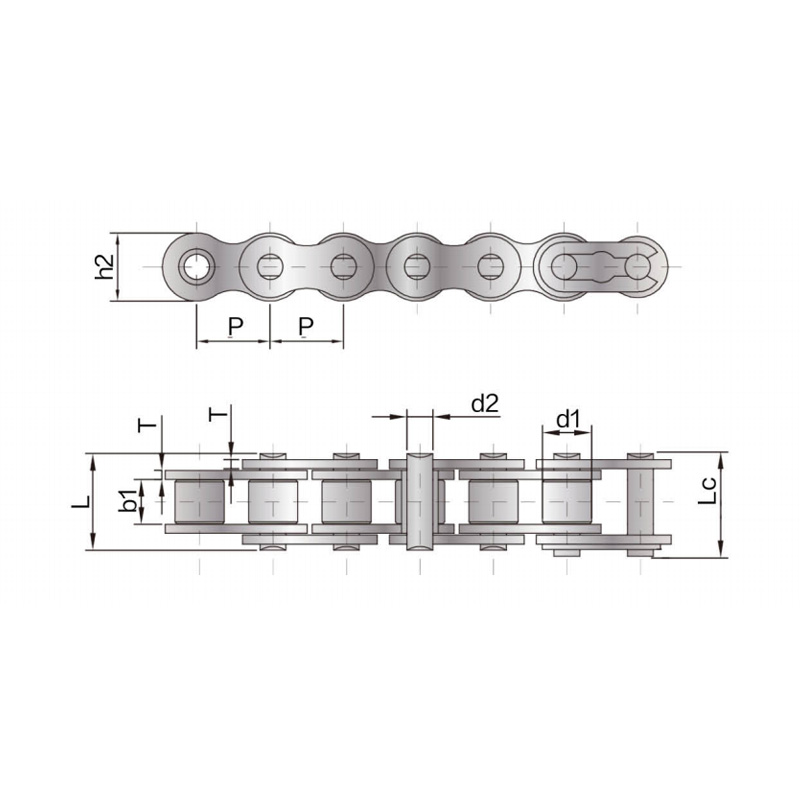 Short Pitch Precision Roller Chain A SeriesA-series roller chain covering ANSI sizes 25–240; use its pitch and four key dimensions to check sprocket fit.View Product →
Pitch only tells you which chain family you are holding. Four dimensions decide whether it will actually sit in the sprocket: pitch, roller diameter, inner width, and pin diameter.
| Chain no. | Pitch (in) | Roller dia. (in) | Inner width (in) | Pin dia. (in) | Min. tensile (lb) |
| 25 | 0.250 | 0.130 | 0.125 | 0.091 | 780 |
| 35 | 0.375 | 0.200 | 0.188 | 0.141 | 1,760 |
| 41 | 0.500 | 0.306 | 0.227 | 0.141 | 1,500 |
| 40 | 0.500 | 0.312 | 0.312 | 0.156 | 3,125 |
| 50 | 0.625 | 0.400 | 0.375 | 0.200 | 4,880 |
| 60 | 0.750 | 0.469 | 0.500 | 0.234 | 7,030 |
| 80 | 1.000 | 0.625 | 0.625 | 0.312 | 12,500 |
| 100 | 1.250 | 0.750 | 0.750 | 0.375 | 19,500 |
| 120 | 1.500 | 0.875 | 1.000 | 0.437 | 28,000 |
| 140 | 1.750 | 1.000 | 1.000 | 0.500 | 38,000 |
| 160 | 2.000 | 1.125 | 1.250 | 0.562 | 50,000 |
| 180 | 2.250 | 1.406 | 1.500 | 0.687 | 63,000 |
| 200 | 2.500 | 1.562 | 1.500 | 0.781 | 78,000 |
| 240 | 3.000 | 1.875 | 1.875 | 0.937 | 113,000 |
The 40 against 41 comparison is the cleanest illustration of why inner width matters. Both run at 0.500 in pitch. The 40 has a 0.312 in inner width and a 0.312 in roller. The 41 has a 0.227 in inner width and a 0.306 in roller. A 41 slipped onto a 40 sprocket gives you a chain that sits laterally loose, rides up the tooth flank under load, and skips.
If none of the 14 sizes lands exactly where you need it, stepping to a neighbouring size is not a small change. A different chain number means a different sprocket, a different centre distance, and sometimes a different housing. The small sizes carry their own published strength data, and a focused look at the ANSI 25 chain specifications shows how quickly the numbers drop at the bottom of the range.
Everything after the base number changes strength or width. None of it changes pitch, which is why the suffix is the second thing to read after the number itself.
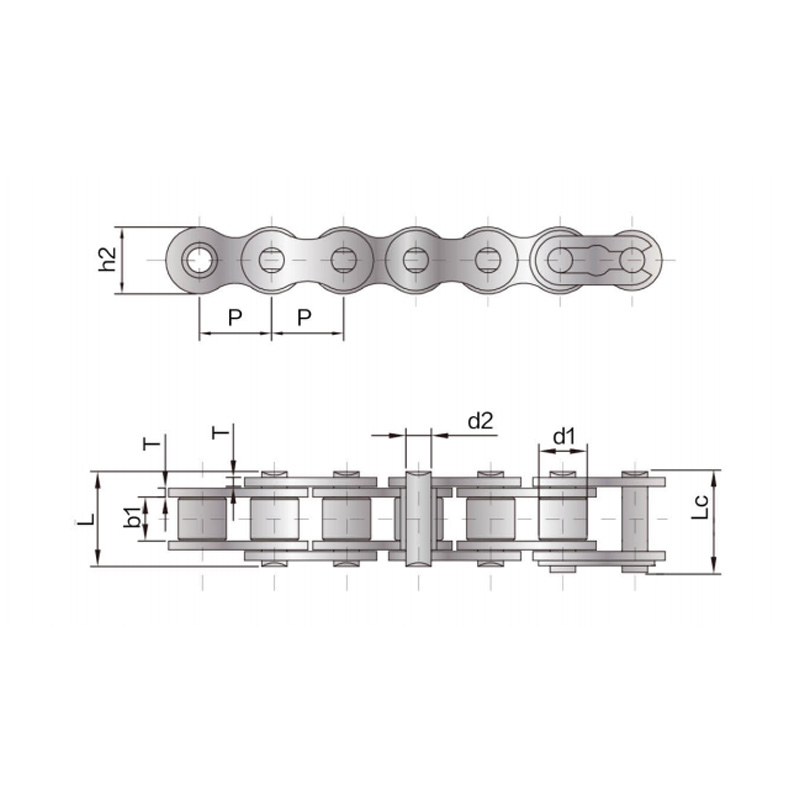 Short Pitch Precision Roller Chain B SeriesB-series roller chain for mechanical drives and conveying; its specification table supports suffix and wear checks after base-number sizing.View Product →
Chain wear shows up as accumulated elongation across many links. Measuring a single link tells you almost nothing, because manufacturing tolerance and pin clearance swamp the wear signal. Measuring twenty links tells you everything.
Replace points vary with the application. Drive chains are usually changed at around 1.5 percent elongation measured this way. Conveyor chains sometimes run to 3 percent. The machine manual outranks any general figure, but 1 percent is the point where you should walk over and inspect the sprocket teeth for hooking as well.
Sprockets are not bought by chain pitch. They are bought by tooth count and pitch diameter, and pitch diameter depends on both the pitch and the number of teeth.
The relationship is pitch diameter equals pitch divided by the sine of 180 degrees over the tooth count. A 25-tooth sprocket for a 50 chain works out to 0.625 divided by the sine of 7.2 degrees, which is 4.987 in. Change the tooth count and the same chain needs a different sprocket, even though the chain number has not moved.
Dimensional accuracy in a stainless chain comes from forming, heat treatment, and inspection, which is why the supplier's test and inspection process matters more than the material table. A chain that measures 0.500 in on the drawing and 0.502 in in the box will wear out a sprocket early, whatever grade the plate is stamped with.
 Custom Sprocket for Roller Chain TransmissionSprocket for mechanical transmission, with A/B/C/D types and customization; pair it with roller chain dimensions and pitch calculations.View Product →
The leading digits divided by eight give the pitch in inches. On a 60 chain, 6 divided by 8 is 0.750 in. The final digit is a variant code and has no effect on pitch.
Not without changing the sprockets. Both run at 0.500 in pitch, but the 40 uses a 0.312 in inner width and roller diameter while the 41 uses 0.227 in inner width and a 0.306 in roller. The 41 sits too loose in a 40 sprocket and climbs the teeth under load.
Measure elongation across twenty links under tension. Drive chains are normally replaced around 1.5 percent elongation and conveyor chains around 3 percent. At 1 percent, inspect the sprocket teeth for hooking.
Some sizes line up closely on pitch. ANSI 40 is close to ISO 08A and ANSI 50 is close to ISO 10A. The ISO B series shares those pitches but uses a different inner width, so verify the dimension table rather than trusting the number on the box.
Our A series short pitch precision roller chains comply with various international standards and are...
See Details
The tensile strength and fatigue strength of the B series short pitch precision roller chain reach 1...
See Details
The Heavy-duty precision roller chain adopts a thickened chain plate design based on the short-pitch...
See Details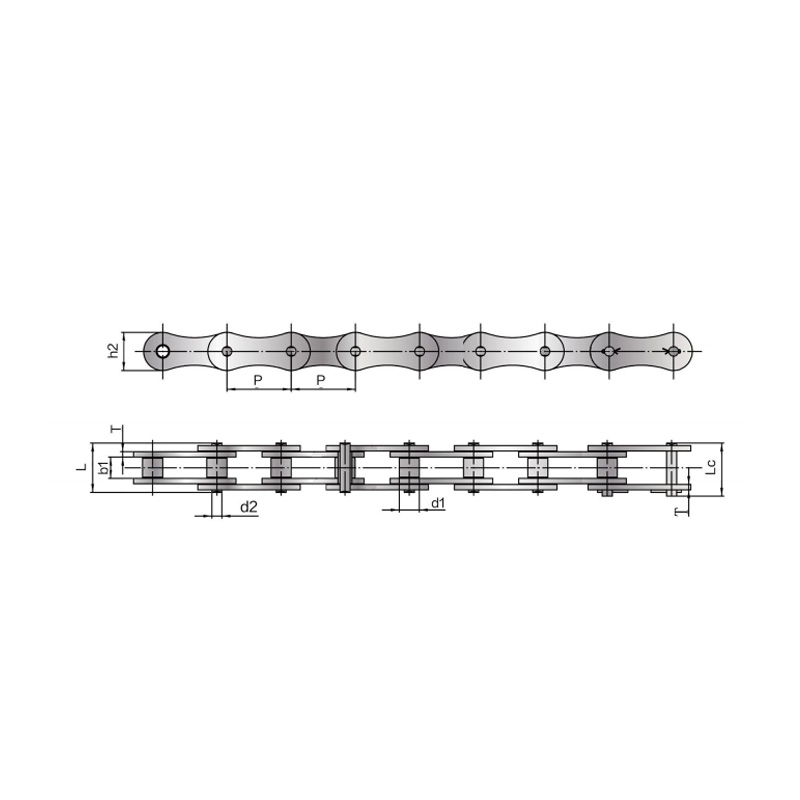
The double pitch driving chain complies with various international standards. The pitch of the doubl...
See Details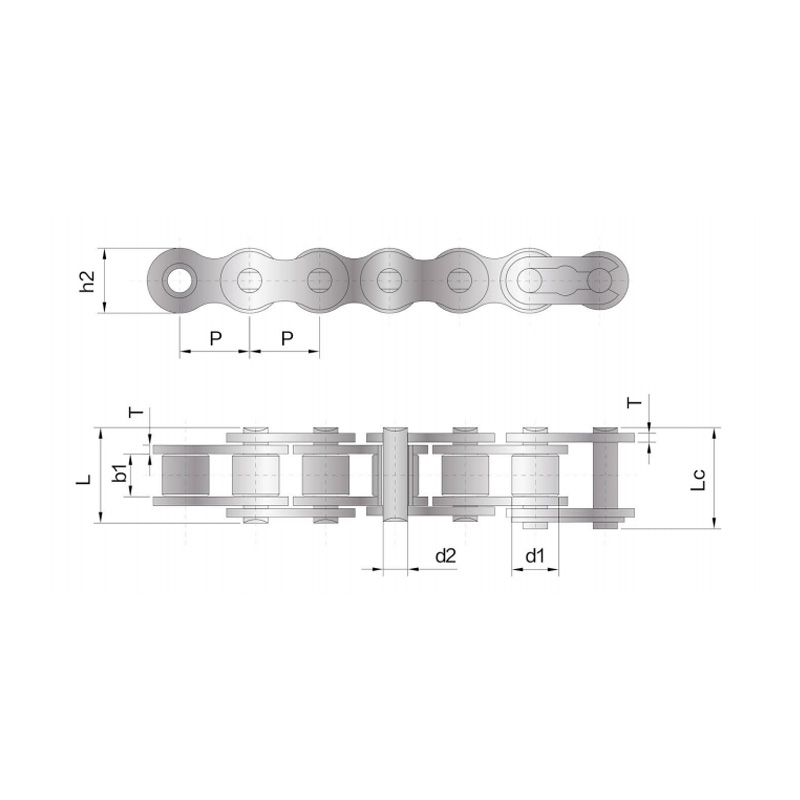
We also produce single row roller drive chains in more sizes and varieties. Customised products, sui...
See Details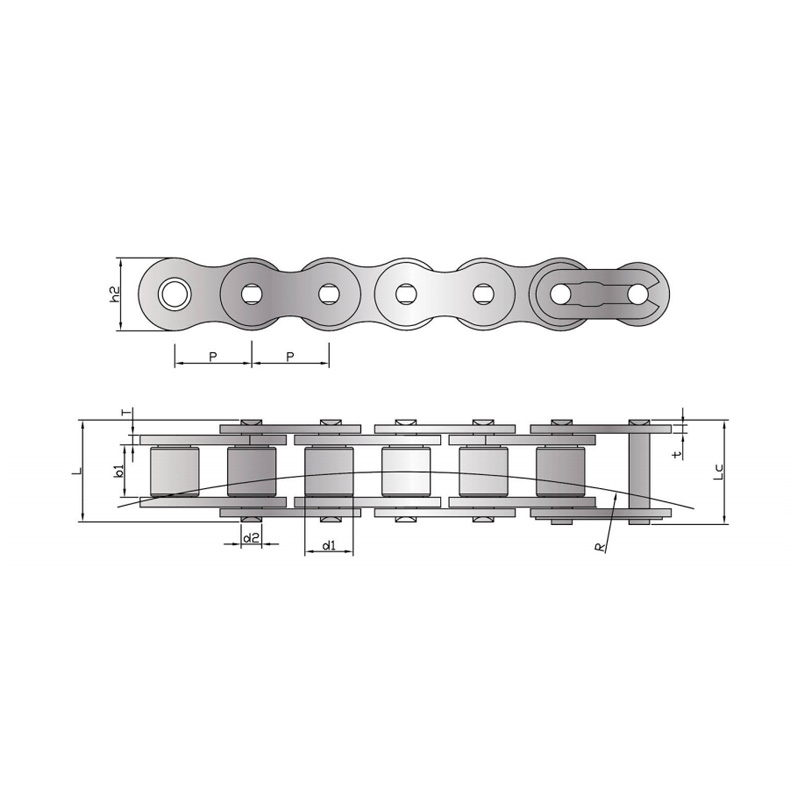
Side bow chain refers to changing the size of parts in the design of short-pitch precision roller ch...
See Details
The Anti-Sidebow chain for pushing window is a functional product with specially designed parts and ...
See Details
The A series short-pitch straight plate precision roller chain has a smaller pitch, a relatively lar...
See Details© Suzhou Fubang Machinery Chain Transmission Manufacturing Co., Ltd. Stainless Steel Roller Chains Manufacturers Conveyor Chains Suppliers
