 简体中文
简体中文 English
 русский
 Español
Fubang is a professional manufacturer specializing in the design, production and sales of stainless steel chains.
Our A series short pitch precision roller chains comply with various international standards and are...
See Details
Content
Searching for “25 chain” can return very different products. In mechanical power transmission, it almost always refers to the ANSI #25 roller chain — the smallest standard size in the roller chain family. It is a 1/4-inch-pitch chain designed for light-duty drives and small conveyor lines. Even though it is small, it carries real loads in packaging equipment, positioning devices, gates, and compact conveyors. Its service life depends less on the chain number than on dimensions, material, sprocket fit, and installation quality. This guide covers the specifications you need, the selection factors that matter, and the practical mistakes to avoid.
Chain numbering follows a logical pattern. In ANSI nomenclature, the first digit or first two digits express pitch in eighth-inch increments. “25” therefore means 2/8 inch, which simplifies to 1/4 inch (6.35 mm). The trailing digit “5” indicates a standard roller chain series. The same logic gives #35 (3/8-inch pitch), #40 (1/2-inch pitch), and #50 (5/8-inch pitch). #25 is the smallest common size, which makes it attractive where space, weight, or inertia is limited.
The dimensions of the chain directly affect how it engages the sprocket teeth. Roller diameter, inner plate width, and pin diameter must match the sprocket profile. If any one dimension is outside the tolerance band, the chain can climb over the teeth, vibrate, or wear at accelerated speed. That is why buying #25 chain by pitch only is never enough.
| Chain No. | Pitch | Roller Diameter | Width Between Inner Plates | Typical Pin Diameter |
|---|---|---|---|---|
| #25 | 0.250 in (6.35 mm) | 0.130 in (3.30 mm) | 0.125 in (3.18 mm) | 0.091 in (2.31 mm) |
| #35 | 0.375 in (9.53 mm) | 0.200 in (5.08 mm) | 0.188 in (4.78 mm) | 0.141 in (3.58 mm) |
| #40 | 0.500 in (12.70 mm) | 0.312 in (7.92 mm) | 0.312 in (7.92 mm) | 0.156 in (3.96 mm) |
These are nominal ANSI dimensions. Actual production chains stay within standard tolerances, and a reliable manufacturer tests dimensions against those limits.
Material selection often has a greater effect on service life than the nominal chain size. Carbon steel is the economical default for dry, low-humidity machines with regular lubrication. It offers good strength and wear resistance, but it is vulnerable to rust in wet environments.
When moisture, washdown chemicals, food acids, or outdoor humidity are present, stainless steel is the safer option. SS304 resists atmospheric and mild chemical corrosion and is common in food and beverage equipment. SS316 adds molybdenum, which improves resistance to chlorides and acidic washdown agents. For applications that require high hardness in a corrosive setting, precipitation-hardening stainless grades can be specified.
Stainless #25 chain costs more than carbon steel, but the longer replacement interval often offsets the initial price.
Because of its compact size, #25 chain fits into locations where a #40 or #50 chain would be too large. It appears in a broad range of light industrial equipment, including:
Its low inertia also makes it easier to start and stop quickly in servo-driven designs.
The working load of a #25 chain is much lower than its ultimate tensile strength. In practice, a safe working load is often one-fifth to one-seventh of the minimum tensile value at moderate speeds. The actual limit depends on operating speed, number of sprocket teeth, chain material, lubrication, and shock load.
For example, a carbon-steel #25 chain may have a minimum ultimate tensile load around 1,575 lbf, but the recommended working load for continuous drive service is typically below 250 lbf, and often lower at high speeds. This is not a sign of low quality; it reflects the fatigue and impact factors that apply to all roller chains. Use tensile strength only as a comparison value, not as the working limit.
For selection logic based on service factor, see our precision roller chain selection guide.
The sprocket is equally important. A #25 chain on a worn or incorrectly cut sprocket develops pitch elongation, vibration, and early failure. For high-cycle drives, use hardened sprocket teeth and confirm bore and keyway dimensions match your shaft.
 Custom Industrial Sprockets for Precision Chain DrivesSprockets must mesh accurately with #25 chains to avoid elongation and vibration. This supplier offers flat, single-hub, double-hub, and assembly types, plus custom options for demanding mechanical transmission applications.View Product →
Precision roller chains are divided into A-series and B-series designs. The distinction comes from the side plate shape: A-series chains use straight side plates, while B-series chains use contoured or waisted side plates. Both meet the same pitch and roller dimensions, so they can be used on the same sprockets, but the side-plate shape changes stiffness and weight.
Straight side plates make an A-series chain very rigid in bending, which suits wide-faced sprockets and long straight runs. For simple replacement of an existing #25 drive, the A-series is usually the fastest route.
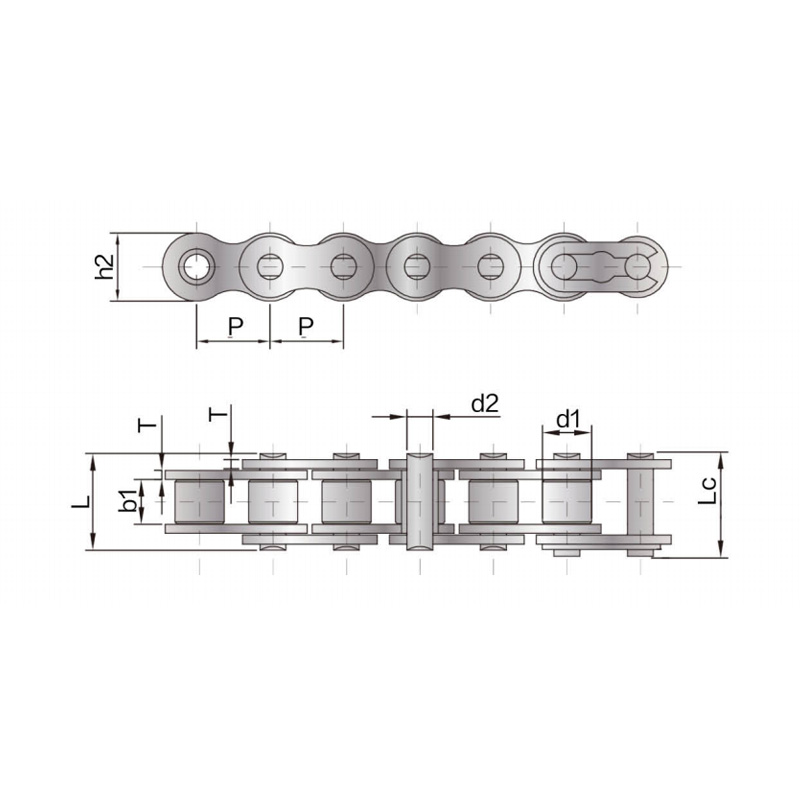 A-Series Short Pitch Precision Roller ChainStraight side plates give this A-series chain rigidity for long straight runs and wide sprockets. It suits simple replacement of existing #25 drives, with high tensile and fatigue strength for heavy, frequent use.View Product →
A B-series chain is lighter for the same pitch because material is removed from the side-plate centre. It is a common choice in European and DIN-based designs, and it is often preferred when the chain must flex over small-diameter sprockets or around obstructions.
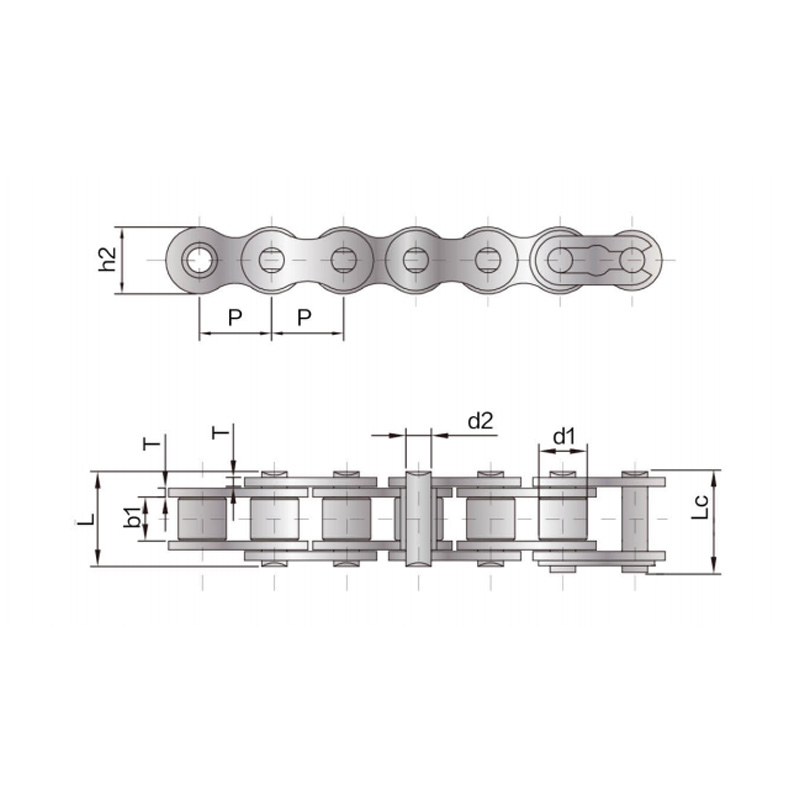 B-Series Short Pitch Precision Roller ChainWith contoured side plates, this B-series chain reduces weight and improves flexibility over small sprockets and obstructions. Its strength exceeds ISO minimums, making it fit for machine tools, conveyors, and food processing equipment.View Product →
The actual grade and material are chosen after the load and environment are defined.
Correct installation has a bigger effect on chain life than any premium material. Start by aligning the two shafts parallel and aligning the sprockets in the same plane; angular misalignment is one of the most common causes of uneven load distribution.
For a horizontal drive, install the chain with a small amount of sag, about 2% of the distance between shaft centres. Tension should be checked and adjusted after the first few hours of operation because initial seating creates slight elongation.
Lubrication is the next priority. Use oil rather than grease when possible; oil penetrates the pins and bushings while grease tends to stay outside. At shop speeds, a light drip feed or periodic relubrication may be enough. For higher speeds, forced lubrication or oil-bath lubrication is required.
Buyers often treat #25 chain as a commodity. In practice, the chain can fail early if you overlook these issues:
These points cover most early failures we see on small drives.
A #25 chain is small, but it still carries real loads in real machines. The right material, sprocket, and maintenance schedule determine whether it lasts months or years. If you are designing or replacing a light-duty drive, start with the dimensions above, then match the material to your environment. For a custom length, stainless option, or full drive package including sprockets, contact us for a quote.

Our A series short pitch precision roller chains comply with various international standards and are...
See Details
The tensile strength and fatigue strength of the B series short pitch precision roller chain reach 1...
See Details
The Heavy-duty precision roller chain adopts a thickened chain plate design based on the short-pitch...
See Details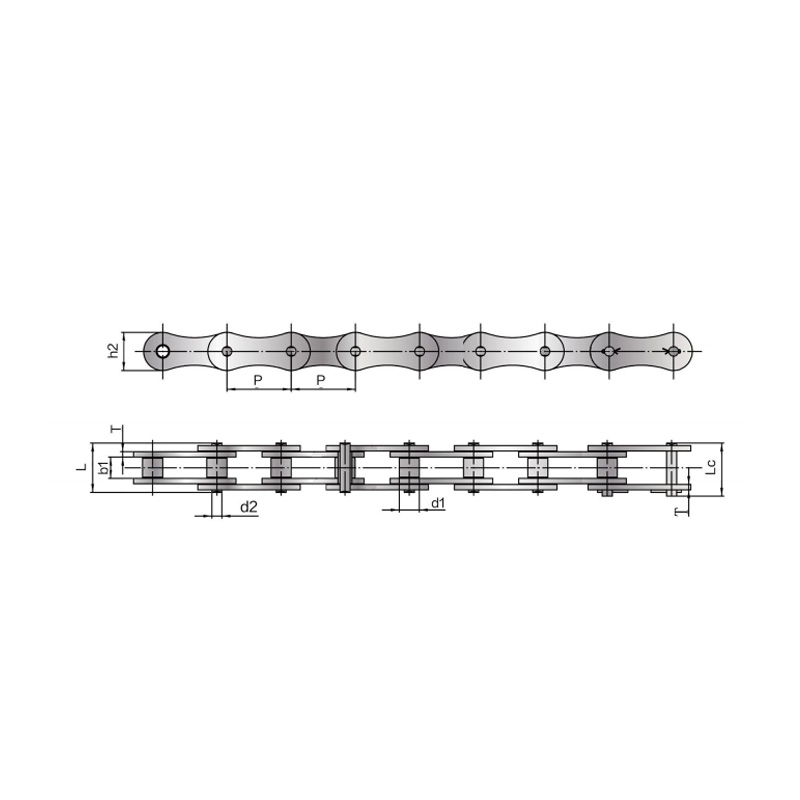
The double pitch driving chain complies with various international standards. The pitch of the doubl...
See Details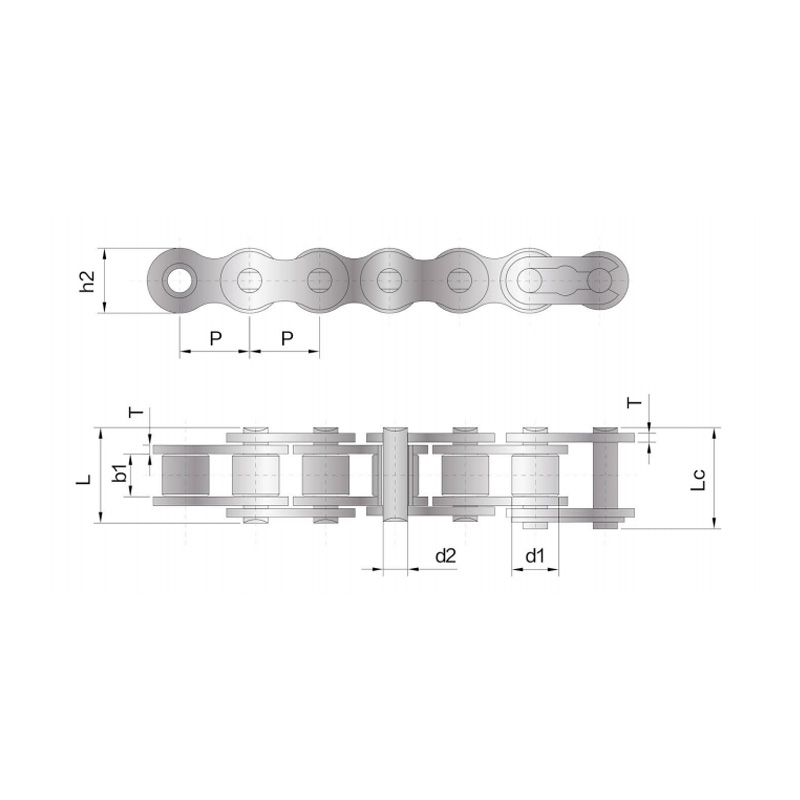
We also produce single row roller drive chains in more sizes and varieties. Customised products, sui...
See Details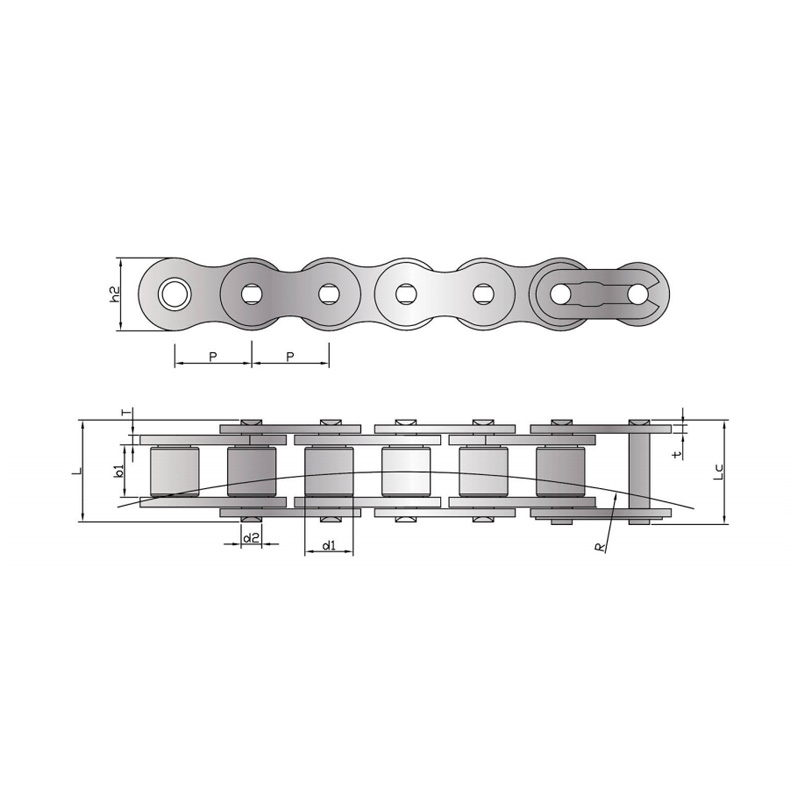
Side bow chain refers to changing the size of parts in the design of short-pitch precision roller ch...
See Details
The Anti-Sidebow chain for pushing window is a functional product with specially designed parts and ...
See Details
The A series short-pitch straight plate precision roller chain has a smaller pitch, a relatively lar...
See Details© Suzhou Fubang Machinery Chain Transmission Manufacturing Co., Ltd. Stainless Steel Roller Chains Manufacturers Conveyor Chains Suppliers
