 简体中文
 English
 русский
 Español

Fubang is a professional manufacturer specializing in the design, production and sales of stainless steel chains.
Our A series short pitch precision roller chains comply with various international standards and are...
See Details
Content
A maintenance technician pulls a stretched chain off a gearbox, measures roughly 19 mm from pin to pin, and orders the replacement by number. That shortcut only works when the number is read correctly. ANSI roller chain sizes are encoded in the chain number itself: the leading digits give the pitch in eighths of an inch, and every other dimension follows from that same pitch family. Confirming a size with a caliper takes a few minutes. Skipping that step is how a chain meant for a #41 sprocket arrives labeled #40, with an identical pitch and a roller that will not seat. The sections below cover the numbering rule, a working size chart, the dimensions the number does not tell you, and how to check a size against a real drive.
An ANSI chain number states its pitch directly: the leading digits multiplied by 1/8 inch give the pitch, so a #40 chain has a 4/8 inch pitch of 12.70 mm and a #60 chain has a 6/8 inch pitch of 19.05 mm. The same rule runs from #25 at 6.35 mm up to #240 at 76.20 mm.
The trailing digit is a variant marker, not part of the pitch. A zero marks the standard single-strand chain. A one or a five marks a lighter chain on the same pitch: #40 and #41 both run at 0.500 inch, but the #41 roller is smaller and its inner width is narrower. Multi-strand versions add a dash and the strand count, so 40-1 is single, 40-2 is double and 40-3 is triple. Double-pitch conveyor chain inserts a 2 in front of the standard number, which is why a 208A runs at 1 inch pitch, twice that of #40, while keeping the same roller and plate dimensions.
Pitch is the center-to-center distance between adjacent pin centers, not the outside length of a link plate. Every other ANSI dimension is referenced back to it.
The full mapping from chain number to millimeter pitch, including the intermediate numbers that rarely appear in catalogs, is covered in our guide to ANSI chain numbering. For buyers converting an old drawing, the pitch fraction is usually the fastest way to identify the family before any other measurement is taken.
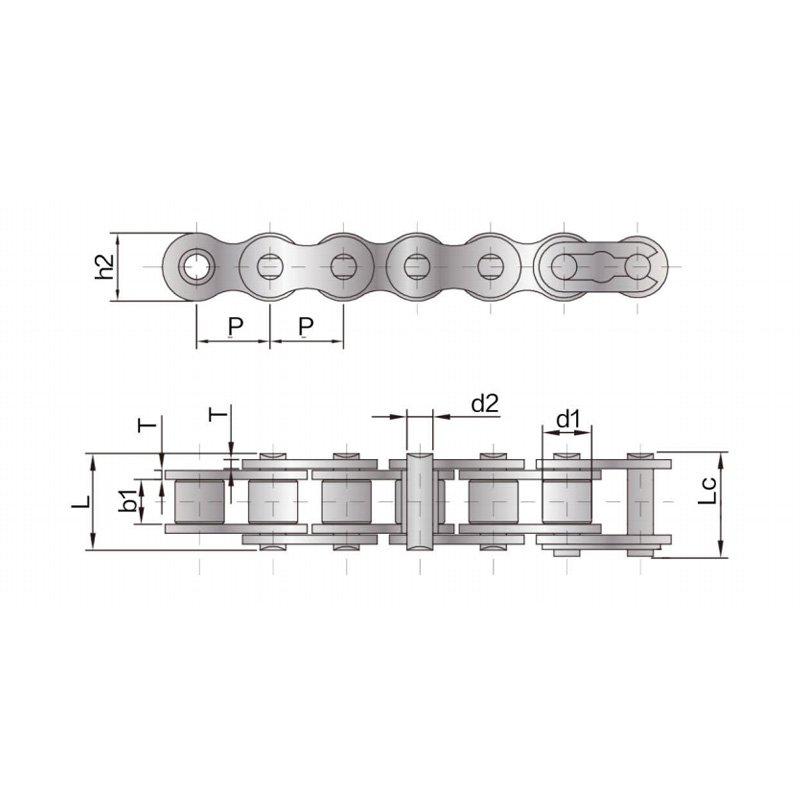 ANSI A-Series Short-Pitch Precision Roller ChainCovers single-strand ANSI sizes with pitch, roller diameter, inner width and tensile strength data for identifying and specifying drive or conveyor chain.View Product →
The table below lists the single-strand ANSI sizes that cover most drive and conveyor work, with pitch, roller diameter and inner width in millimeters, plus typical minimum tensile strength for standard carbon steel chain.
| Chain number | Pitch (in) | Pitch (mm) | Roller dia (mm) | Inner width (mm) | Tensile (kN) |
| #25 | 0.250 | 6.35 | 3.30 | 3.18 | 3.5 |
| #35 | 0.375 | 9.53 | 5.08 | 4.78 | 7.9 |
| #40 | 0.500 | 12.70 | 7.92 | 7.92 | 17.6 |
| #50 | 0.625 | 15.88 | 10.16 | 9.53 | 29.4 |
| #60 | 0.750 | 19.05 | 11.91 | 12.70 | 37.8 |
| #80 | 1.000 | 25.40 | 15.88 | 15.88 | 64.5 |
| #100 | 1.250 | 31.75 | 19.05 | 19.05 | 107 |
| #120 | 1.500 | 38.10 | 22.23 | 25.40 | 151 |
| #160 | 2.000 | 50.80 | 28.58 | 31.75 | 258 |
| #200 | 2.500 | 63.50 | 38.10 | 38.10 | 378 |
| #240 | 3.000 | 76.20 | 47.63 | 50.80 | 508 |
Treat the tensile column as a starting point rather than a fixed property of the number. Published minimum tensile values move with manufacturer, heat treatment and material, and stainless grades in the same chain number rate lower than carbon steel. A double-strand version of the same size will list a different figure again, because the number describes geometry, not load capacity.
The chain number is a geometry key, not a strength rating. Two #80 chains from different makers can measure the same pitch, roller and width yet list noticeably different minimum tensile values.
Pitch sets tooth spacing, but roller diameter and inner width decide whether a chain seats in the sprocket and clears the surrounding structure. ANSI #40 and #41 both run at 12.70 mm pitch. The #40 roller measures 7.92 mm with a 7.92 mm inner width, while the #41 roller measures 7.77 mm with a 6.35 mm inner width. A #41 dropped onto a #40 sprocket sits lower in the tooth gap and loads the tooth flank on the wrong contact line, which shows up as noise and rapid tooth wear long before the chain breaks.
Replace a drive chain once elongation reaches about 1.5 percent, measured across ten or more pitches. A single-pitch measurement is too short to reveal wear and will pass chains that are already damaging sprockets.
#40 and 08B both measure 12.70 mm pitch, but their roller diameters and inner widths differ, so one cannot replace the other on the same sprocket. The same pattern repeats up the size range: #60 and 12B share a 19.05 mm pitch while carrying a 11.91 mm roller against 12.07 mm, and a 12.70 mm inner width against 11.68 mm. Matching the pitch is only the first check; the roller has to match the sprocket tooth root as well.
When a machine arrives with a European drawing, order by the ISO or DIN number and the ANSI number separately. Converting one to the other by pitch alone is how mismatched sprocket sets end up on the same shaft.
Plants running mixed equipment often standardize on one footprint. Where the drawing is BS or DIN, a B-series short-pitch chain keeps the roller and width dimensions that the original sprockets were cut for, and spares can be held against a single reference instead of two parallel sets.
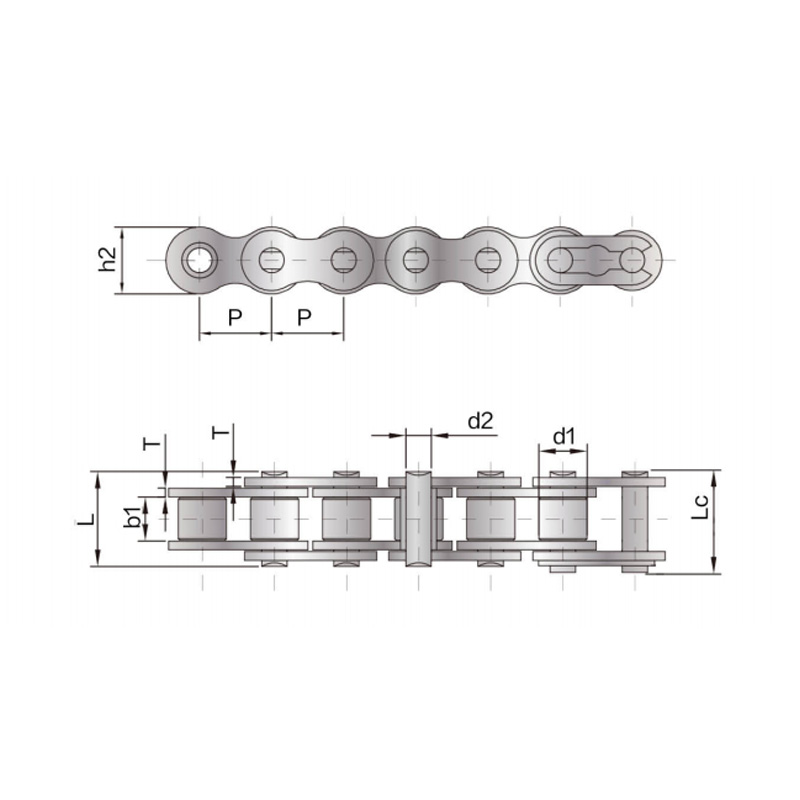 B-Series Short-Pitch Precision Roller Chain for BS/DIN DrivesKeeps BS/DIN roller and width dimensions for existing sprockets, with tensile and fatigue strength at least 1.1 times ISO minimum.View Product →
Size a chain from the sprocket outward: confirm pitch and tooth count first, then check roller diameter, inner width and tensile against the actual load and the working environment. Working in the reverse order, from a catalog tensile figure back to a chain number, usually produces an oversized chain that will not fit the housing.
Stainless grades such as SS304, SS316, SS420 and duplex SS2205 hold the same ANSI geometry but carry lower tensile than carbon steel for the same chain number, commonly one third to one half of the carbon-steel figure depending on grade. Sizing that keeps the carbon-steel number and simply swaps the material will under-rate the drive. Chain and sprocket also need to be ordered as a matched pair, because a new chain on a worn sprocket wears out in a fraction of its expected life.
Sending the chain number, the strand count and a photo of the sprocket resolves most sizing questions in one exchange. Dimensions and material grade are the two details that cannot be inferred from the machine alone.
 Customizable Transmission Sprockets for Mechanical Drive SystemsOffered in flat, single-sided, double-sided and assembly types, with customization for chemical, textile, food-processing, instrumentation and petroleum machinery applications.View Product →
If the original plate is unreadable, send us the measured pitch, roller diameter and sprocket tooth count and the matching size can be confirmed against the drawing before anything is cut.
Short answers to the sizing questions that come up most often on drive and conveyor retrofits.
The 4 is multiplied by 1/8 inch to give a 0.500 inch pitch, which equals 12.70 mm. The trailing 0 marks the standard single-strand version of that pitch, while a 1 or a 5 would indicate a lighter variant with a different roller and width.
No. Both have a 12.70 mm pitch, but the #40 roller measures 7.92 mm and the 08B roller 8.51 mm, with inner widths of 7.92 mm and 7.75 mm respectively. The two chains do not run correctly on each other's sprockets.
Measure center to center across several pin pairs, divide by the number of pitches to get the average pitch, then multiply by 8 to express it in eighths of an inch. An average pitch of 0.500 inch points to the #40 family, after which roller diameter separates #40 from #41.
The suffix gives the strand count. A 40-2 is a two-strand chain on the same 12.70 mm pitch as a single-strand #40, and its minimum tensile strength is roughly 1.75 times higher, while the sprocket must be cut for two strands.
Our A series short pitch precision roller chains comply with various international standards and are...
See Details
The tensile strength and fatigue strength of the B series short pitch precision roller chain reach 1...
See Details
The Heavy-duty precision roller chain adopts a thickened chain plate design based on the short-pitch...
See Details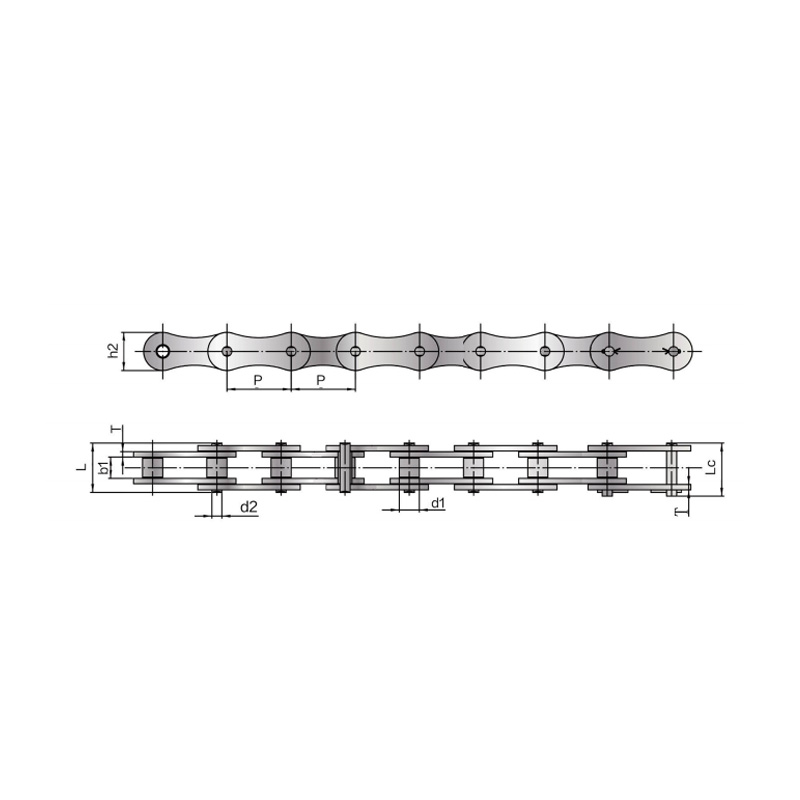
The double pitch driving chain complies with various international standards. The pitch of the doubl...
See Details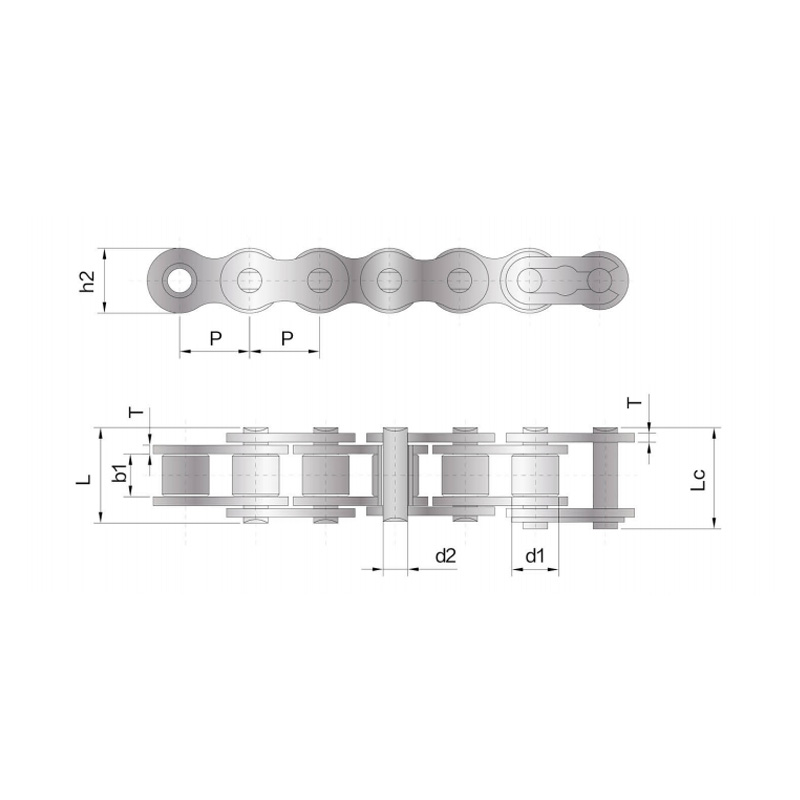
We also produce single row roller drive chains in more sizes and varieties. Customised products, sui...
See Details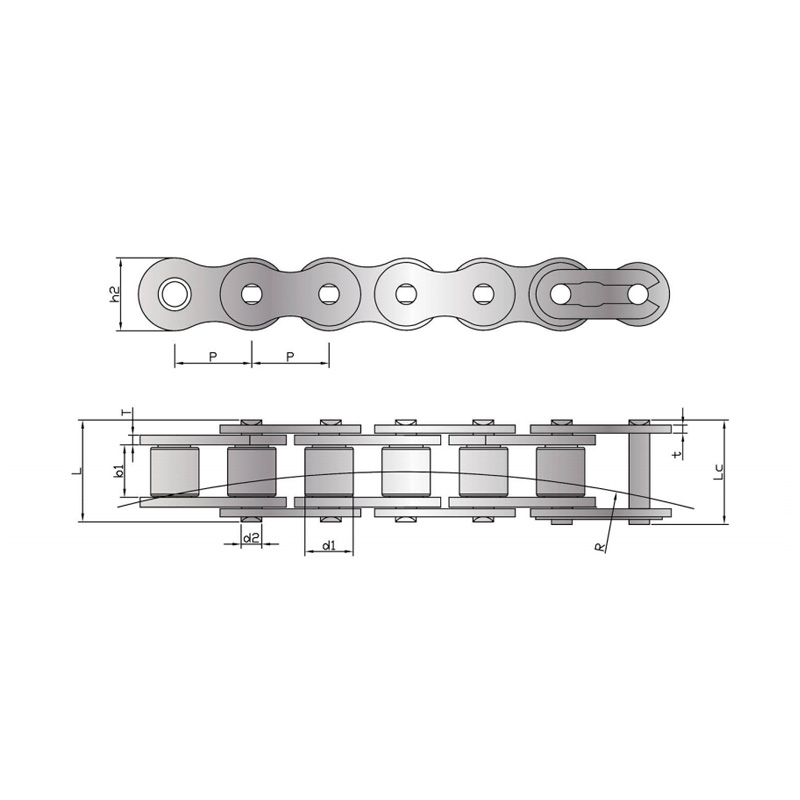
Side bow chain refers to changing the size of parts in the design of short-pitch precision roller ch...
See Details
The Anti-Sidebow chain for pushing window is a functional product with specially designed parts and ...
See Details
The A series short-pitch straight plate precision roller chain has a smaller pitch, a relatively lar...
See Details© Suzhou Fubang Machinery Chain Transmission Manufacturing Co., Ltd. Stainless Steel Roller Chains Manufacturers Conveyor Chains Suppliers
