 简体中文
 English
 русский
 Español

Fubang is a professional manufacturer specializing in the design, production and sales of stainless steel chains.
Our A series short pitch precision roller chains comply with various international standards and are...
See Details
Content
A buyer sends out a request for forty chain, ten feet. Three quotes come back at three prices, and in the fine print one supplier is offering 08B, one is offering a lightweight 41, and one is offering exactly what was asked for. The gap is not salesmanship. It is the difference between a chain number and a chain standard. An ANSI standard roller chain is defined by one document, ASME B29.1, and every dimension that decides fit, load and service life hangs off the number printed on the box.
An ANSI standard roller chain is a precision roller chain whose pitch, roller diameter, inner width, pin diameter and plate proportions are all fixed by ASME B29.1, so a number 40 chain from any compliant manufacturer will seat correctly on a number 40 sprocket.
That sentence is doing the real work. The standard exists so a replacement chain bought in Southeast Asia fits a sprocket machined in Ohio. Every link carries five load-bearing parts: the pin, the bushing, the roller, and the two plates that hold them together. Pitch, the center-to-center distance between adjacent pins, is the dimension the entire numbering system is built on.
The digits before the dash give pitch in eighths of an inch, so a 60 chain has a pitch of 6/8 inch, or 3/4 inch, and a 100 chain has a pitch of 10/8 inch, or 1-1/4 inch.
Read left to right up to the dash, then deal with the suffix. Three rules cover most catalog rows:
The same decoding logic, with load data attached, is set out in this guide to how ANSI roller chain numbers map to pitch, roller size and load.
| Chain no. | Pitch, in / mm | Roller dia., mm | Inner width, mm | Tensile, kN | Typical duty |
| 25 | 1/4 / 6.35 | 3.30 | 3.18 | 3.5 | Small drives, indexing units |
| 35 | 3/8 / 9.53 | 5.08 | 4.78 | 9.3 | Packaging lines, light conveyors |
| 40 | 1/2 / 12.70 | 7.94 | 7.85 | 17.6 | General drives, augers, fans |
| 50 | 5/8 / 15.88 | 10.16 | 9.53 | 27.0 | Pumps, mixers, compressors |
| 60 | 3/4 / 19.05 | 11.91 | 12.70 | 38.0 | Conveyors, crushers |
| 80 | 1 / 25.40 | 15.88 | 15.75 | 64.0 | Heavy drives, mining plant |
| 100 | 1-1/4 / 31.75 | 19.05 | 18.90 | 97.0 | Large reducers, kiln drives |
ANSI A-series chain and ISO/DIN B-series chain are not interchangeable even when their nominal pitch is identical, because roller diameter, inner width and sprocket tooth profile all differ.
The most common mix-up is 40 against 08B. Both run on a 12.70 mm pitch, so in a photograph they look like the same part. In a sprocket they are not.
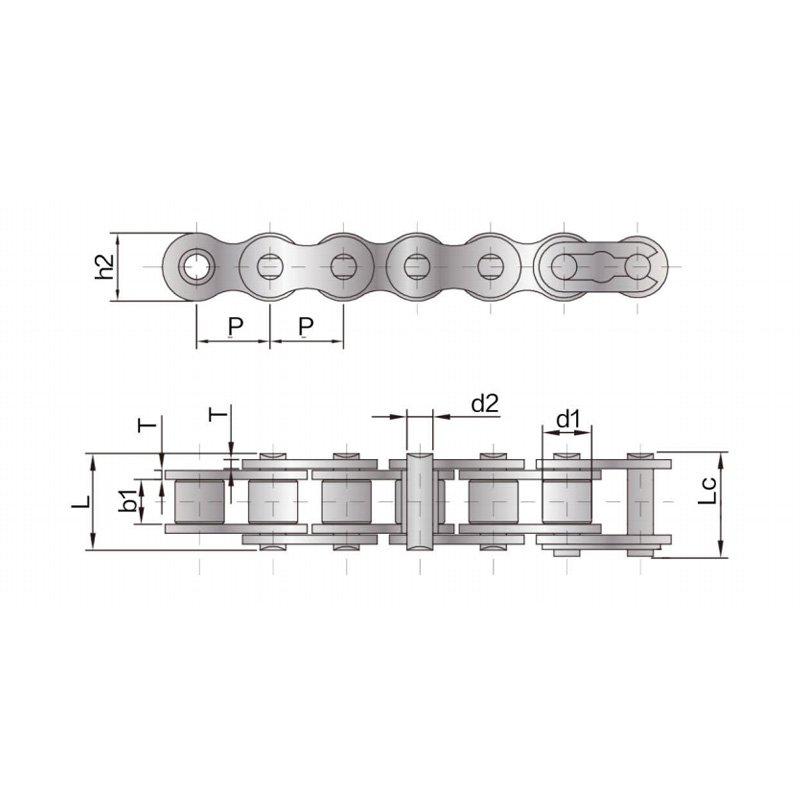 A-Series Short-Pitch Precision Roller ChainUse the published pitch, roller and tensile table to distinguish common ANSI sizes and choose a matching A-series drive chain.View Product →
The same ANSI number is produced in carbon steel and in several stainless grades, and the rated tensile strength falls when you move to austenitic stainless.
Carbon steel with through-hardened pins and bushings remains the default: highest strength per size, lowest cost, and it needs lubrication to survive. Where the chain sees washdown, food contact or chemical mist, the alloy changes and so does the catalog row.
Ask for the tensile figure at the same time you ask for the drawing. A 40 chain in 304 stainless is dimensionally identical to a carbon steel 40 and noticeably weaker, so a drive sized purely on the standard number can end up undersized. Hardness and dimensional checks on each batch are what catch that before dispatch, which is why the manufacturing and testing setup behind the chain matters as much as the number on the label.
Heavy series keeps the pitch and roller of the base number and adds plate thickness, while double pitch doubles the pitch and halves the link count for conveyor duty.
Compare 60H against 60. Both run at a 19.05 mm pitch with the same roller, but the H version carries thicker link plates, more bearing area on the pin and better tolerance of shock loads and abrasive dust. Published tensile gains are modest and vary by maker, so if you need more strength, step up the number. If you need plate life under impact, take the H.
 Heavy-Duty H-Series Roller ChainFor 60H versus 60, the thickened-plate H series offers single- and double-strand sizes with published tensile and weight data.View Product →
Double pitch is a different trade. A 2080 runs at twice the pitch of an 80 with half as many links per meter, which cuts chain weight and cost on long, slow conveyors. Rollers come in standard and large diameters, and the large roller version copes better with accumulation and rough product contact.
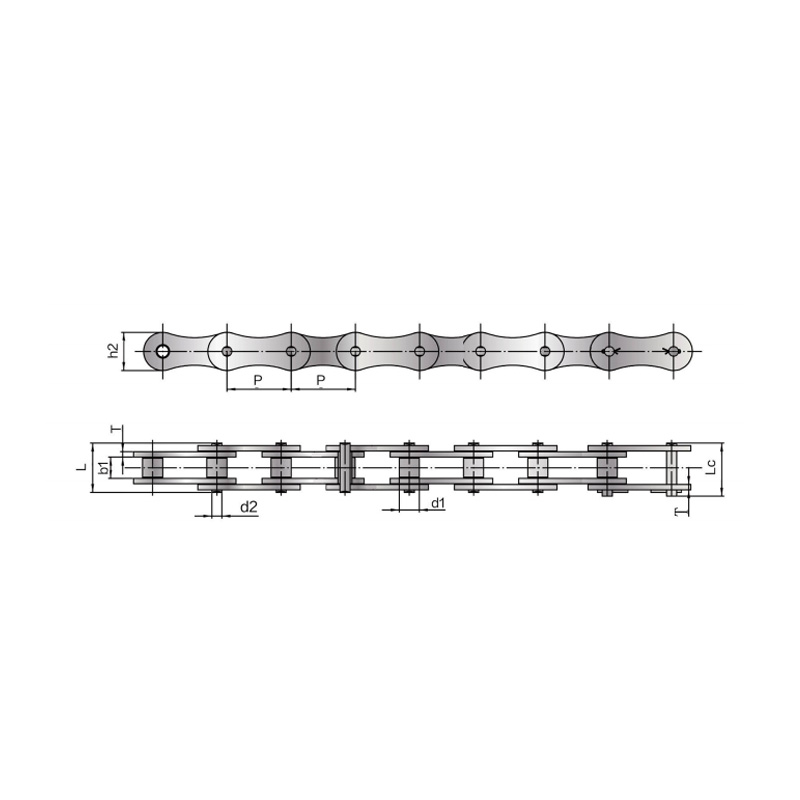 A- and B-Series Double-Pitch Driving ChainTwice the pitch of short-pitch chain with matching tensile and hinge area, lighter for lower-speed, longer-center drives; see the A/B model table.View Product →
Six checks catch almost every ANSI chain selection mistake before the order leaves the building.
No. Both use a 12.70 mm pitch, but the roller diameter is 7.94 mm against 8.51 mm and the inner width is 7.85 mm against 7.75 mm. Each will run on its own sprocket and neither seats properly on the other.
It marks the heavy series: same pitch and roller as a standard 60, with thicker link plates and more pin bearing area. Shock tolerance and plate life improve, while the tensile gain is smaller than most buyers expect, so check the maker's data rather than assuming a jump in strength.
Dimensionally yes, when the number and series match, but the load rating is lower. Recalculate the working load with a service factor before swapping materials, particularly on drives already running close to their limit.
Measure across ten pitches and divide by ten for pitch, then measure roller diameter and inner width and match the values to a catalog row. Check plate thickness as well, since a heavy series chain otherwise measures like its standard equivalent.
Our A series short pitch precision roller chains comply with various international standards and are...
See Details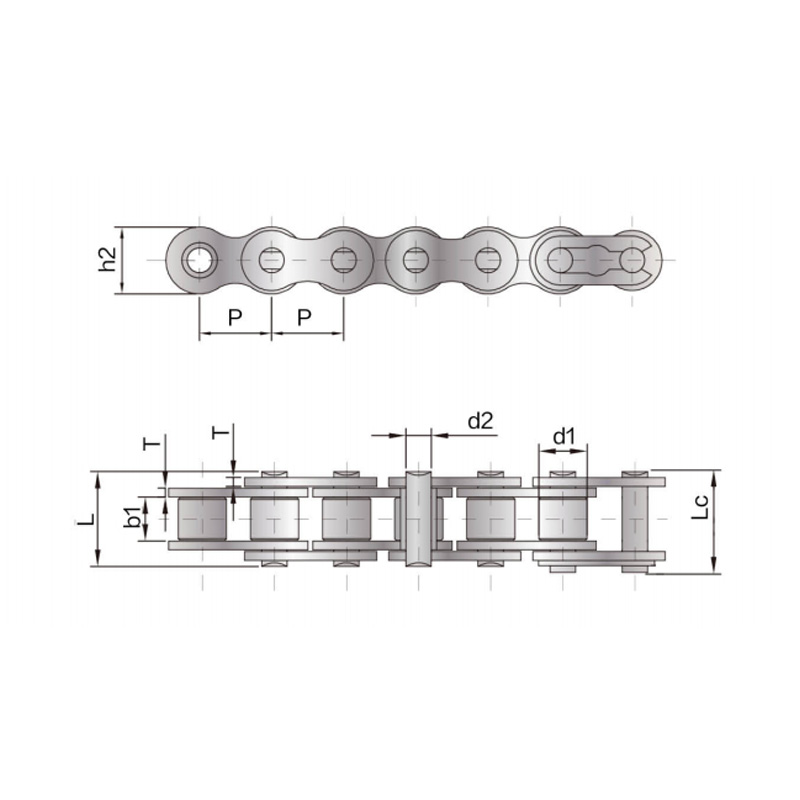
The tensile strength and fatigue strength of the B series short pitch precision roller chain reach 1...
See Details
The Heavy-duty precision roller chain adopts a thickened chain plate design based on the short-pitch...
See Details
The double pitch driving chain complies with various international standards. The pitch of the doubl...
See Details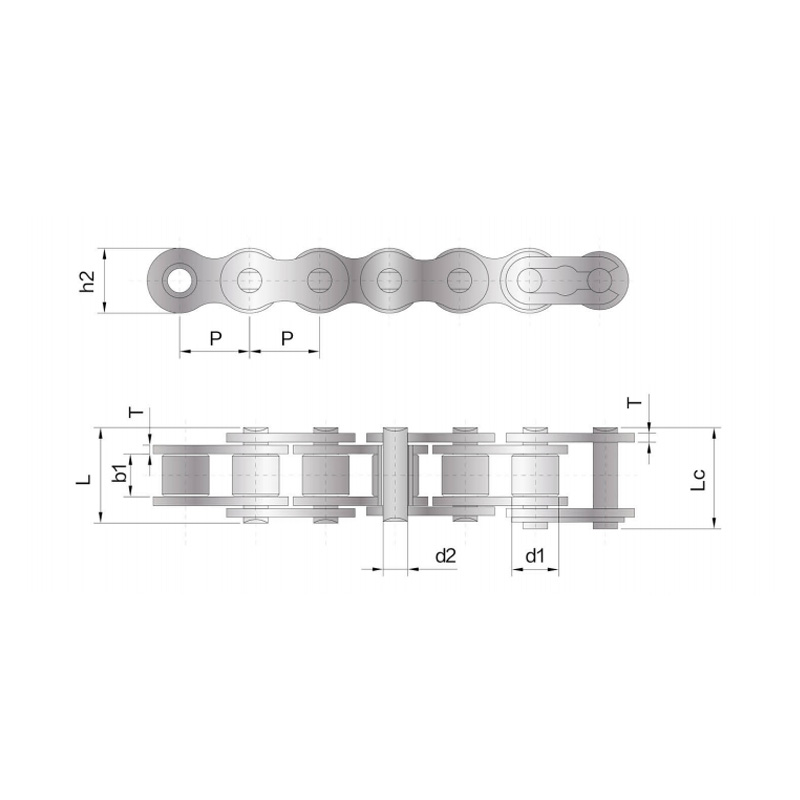
We also produce single row roller drive chains in more sizes and varieties. Customised products, sui...
See Details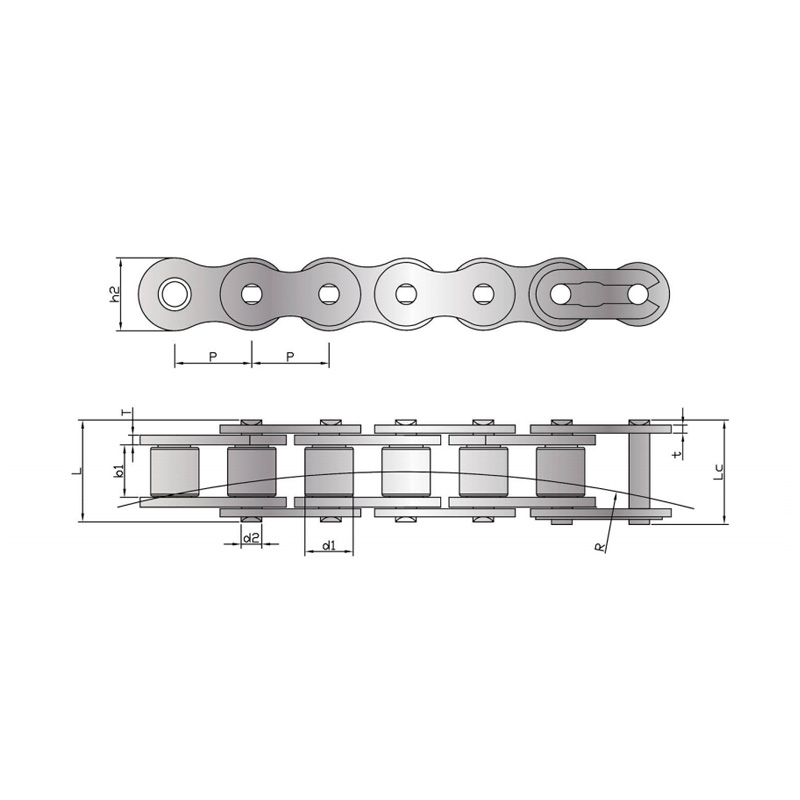
Side bow chain refers to changing the size of parts in the design of short-pitch precision roller ch...
See Details
The Anti-Sidebow chain for pushing window is a functional product with specially designed parts and ...
See Details
The A series short-pitch straight plate precision roller chain has a smaller pitch, a relatively lar...
See Details© Suzhou Fubang Machinery Chain Transmission Manufacturing Co., Ltd. Stainless Steel Roller Chains Manufacturers Conveyor Chains Suppliers
