 简体中文
 English
 русский
 Español

Fubang is a professional manufacturer specializing in the design, production and sales of stainless steel chains.
Our A series short pitch precision roller chains comply with various international standards and are...
See Details
Content
A flight bar bracket tears out of its chain plate after eight months, and a bottling line loses a weekend to the repair. The chain gets the blame, but the damage almost always starts at the attachment point: a hole drilled into a standard link plate, a bracket welded onto hardened carbon steel, or a tab loaded sideways against the direction it was formed for. Purpose-built attachment roller chains exist so that none of those improvisations are needed.
Working definition
An attachment roller chain is a roller chain in which selected link plates, or the pins themselves, are extended with a formed attachment such as a bent tab, a straight tab, an extended pin or a custom bracket, so that a fixture can be bolted to the chain at a fixed and repeatable pitch.
The rest of this guide follows the order a quotation gets built in: which attachment patterns exist, which dimensions have to match the frame drawing, when stainless earns its premium, and where these chains fail first on a running line.
Attachment patterns fall into two mechanical families: bent tabs that stand off the side of the chain, and straight tabs or extended pins that present a mounting face parallel to the direction of travel. Nearly every catalogue pattern is a variation on those two ideas.
| Pattern | Form | Mounting face | Typical duty |
| A-type | Tab bent to one side, one or two holes | Vertical, offset from the plate | Single flight or pusher on one edge of the strand |
| K-type | Tabs bent on both sides and aligned | Vertical, both edges | Cross bars spanning two chain strands |
| SA and SK | Straight tab with holes through the flat | Parallel to the plate | Fixtures bolted flat, indexing and accumulating lines |
| D-type | Extended pin with a hole or thread | At the pin end | Slat and apron conveyors, rods carried between chains |
| Special | Formed bracket to drawing | Application specific | Unbalanced tooling, guide brackets, OEM conveyor designs |
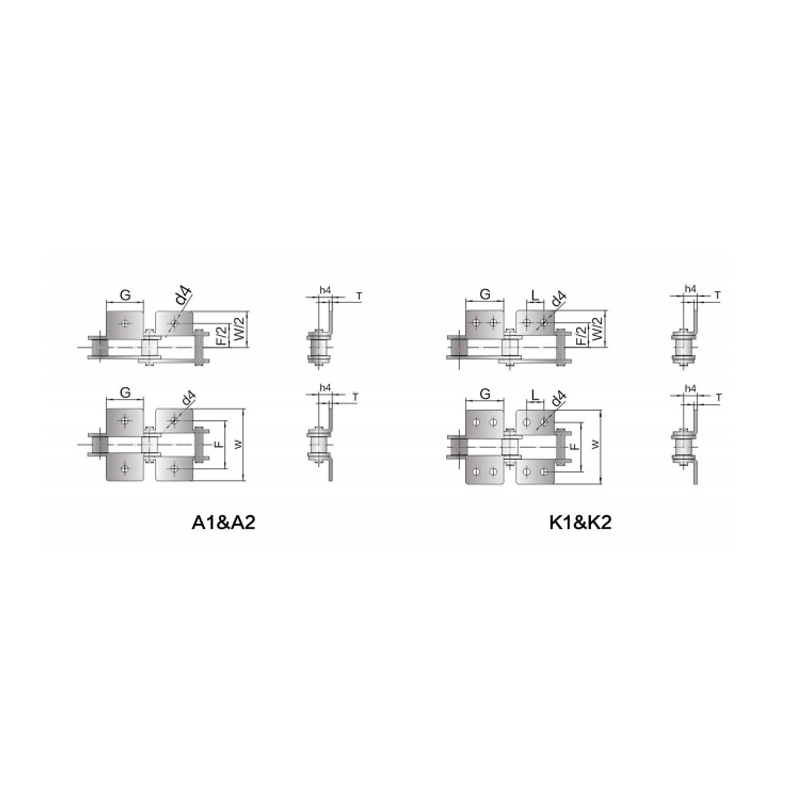
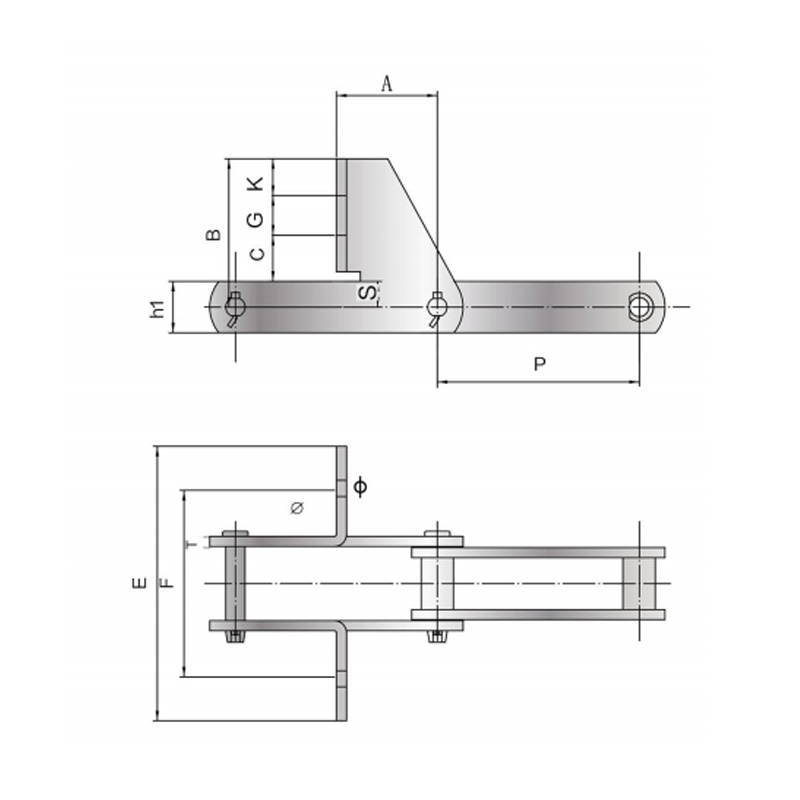
A-type tabs are bent at roughly 90 degrees to one side of the plate, and the number in the suffix tells you how many holes the tab carries: A1 has one, A2 has two. K-type duplicates the tab on both sides of the chain and aligns the two hole centres. Bent tabs are loaded in bending, so bend radius and plate thickness decide fatigue life far more than the plan area of the tab.
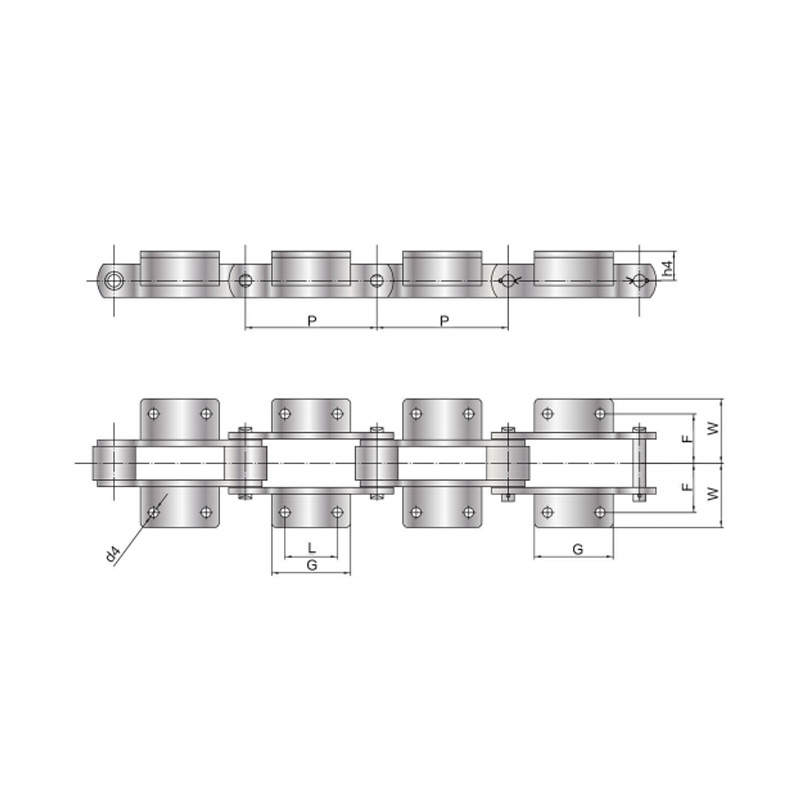
SA and SK tabs stay flat and parallel to the plate, which puts the bolt axis across the chain and lets a fixture sit tight against the frame. D-type extended pins push a longer pin through the link so a rod, slat or cross bar can hang between two strands, which is the usual arrangement on apron and slat conveyors.
Mounting points on a standard attachment chain sit on pin links, so tabs repeat every two pitches: 25.4 mm on an 08B chain and 76.2 mm on a 24B chain. If the fixture grid does not divide into that repeat, the answer is a different pitch or a special pattern, never a drilled plate.
 Double Pitch Conveyor Chain with Attachment TabsDurable conveyor chain with attachment tabs for conveying setups; customizable per drawings or working conditions, with multiple model dimensions for fit selection.View Product →
Attachment chains are dimensioned parts, not adaptable ones. Hole centre height, tab thickness, hole diameter and repeat spacing settle fit long before strength is discussed.
Before a drawing is released, check these points against the roller chain components that actually carry the load, because each one has caused a rework at some point:
Drawing tip
Dimension the attachment from the pin centre line, not from the plate edge. Plate edges vary with wear and between manufacturers, while the pin centre is the only datum that stays true for the life of the chain.
 M-Series Attachment Conveyor Chain with Solid PinsConfigurable M-series conveyor chain with attachments and solid pins; model table covers pitches and dimensions to support selection and customization.View Product →
Washdown, chemicals and temperature decide the material long before load does. A chain that is strong enough but pits at the attachment hole will fail years earlier than one that is modestly over-specified.
| Material | Corrosion behaviour | Where it fits |
| 304 stainless | Good general resistance | Food areas with clean water rinse and routine cleaning |
| 316 stainless | Resists chlorides and cleaning chemicals | Dairy, brewing, coastal plants, CIP washdown |
| 2205 duplex | High chloride and stress corrosion resistance | Brine, heavy washdown, warm wet duty |
| Nickel-plated carbon steel | Dry protection only | Dry indoor conveying and packaging lines |
| 410 and 420 grades | Hard but limited corrosion resistance | Wear-driven dry duty, pins and rollers |
Grade note
A 304 chain in a chloride washdown will pit at the attachment hole before the roller path shows real wear, because the hole is a crevice where liquid sits after the line stops. Above roughly 200 ppm chloride in the wash water, specify 316 or 2205 and rinse the tab faces at shutdown.
 Stainless Steel Conveyor Chain with Attachment PlatesStainless steel conveyor chain with adjustable attachment plates for removing solid pollutants in sewage treatment; multiple models and dimensions available.View Product →
A purpose-made attachment chain wins on repeatability and service life; a welded or drilled fixture wins only on the cost of the first prototype.
Rule of thumb
If the fixture will be replaced more than twice in the life of the line, or if it has to sit within a millimetre of the same position after every rebuild, buy the attachment chain rather than fabricating one.
Failures cluster at the attachment rather than on the roller path, and they usually show up as elongation at the hole long before a plate actually breaks.
If a tab has been bent to make holes line up during installation, its fatigue margin is already gone. Misalignment is a specification problem, not an installation problem.
Four decisions, taken in this order, prevent nearly every attachment problem that ends up as a warranty claim.
Order with the fixture drawing attached. Hole positions, tab height and the number of tabs per strand are the three items that most often need a second round of questions.
Send the fixture drawing with hole spacing and load figures to the Fubang engineering team, and the quotation can usually be built in one round instead of three.
Quick answer
Most attachment chain failures trace back to a drilled or welded standard plate, or to a fixture load that was never compared with the tab geometry. Match pattern and load first, then choose the material.
Not reliably. Drilling or welding a standard plate removes the hardened case and leaves a stress raiser exactly where the tab carries load. Purpose-made attachment links, or a complete attachment chain, keep the plate heat treatment intact.
A-type tabs are bent to one side of the chain, while K-type tabs are bent on both sides and aligned with each other. A-type suits a flight on one edge of the strand; K-type suits a cross bar spanning between two strands.
Yes. An offset load on a tab puts a bending moment into the plate that a plain chain never sees, so usable tension sits below the catalogue tensile strength, and the derating grows with tab length and overhung mass.
Check tab holes and bolt torque at every lubrication interval, measure elongation across ten pitches monthly on a continuously running line, and plan replacement at around 1.5% elongation before hole wear accelerates.
Our A series short pitch precision roller chains comply with various international standards and are...
See Details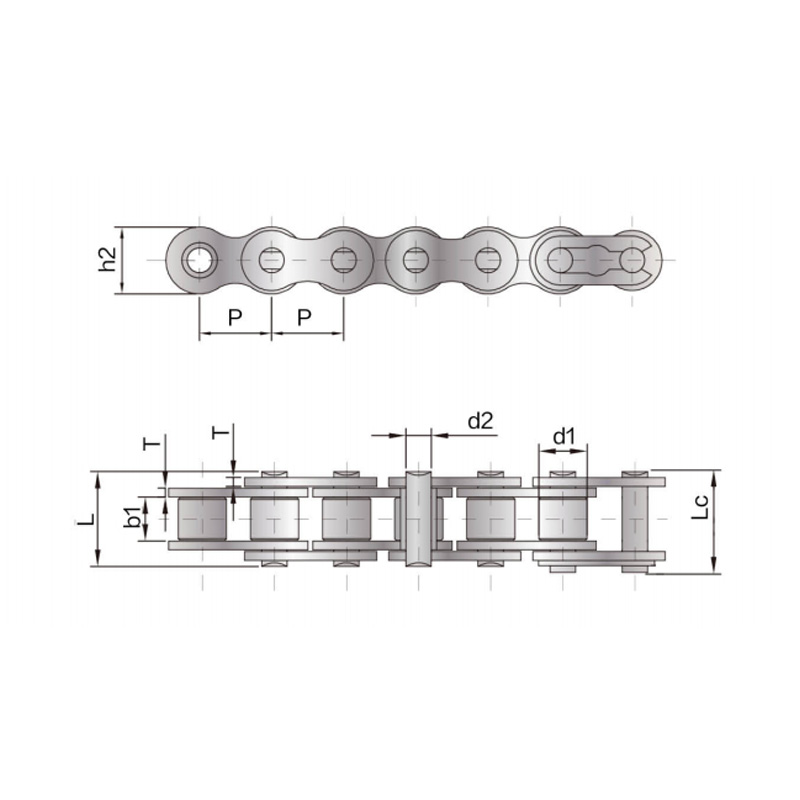
The tensile strength and fatigue strength of the B series short pitch precision roller chain reach 1...
See Details
The Heavy-duty precision roller chain adopts a thickened chain plate design based on the short-pitch...
See Details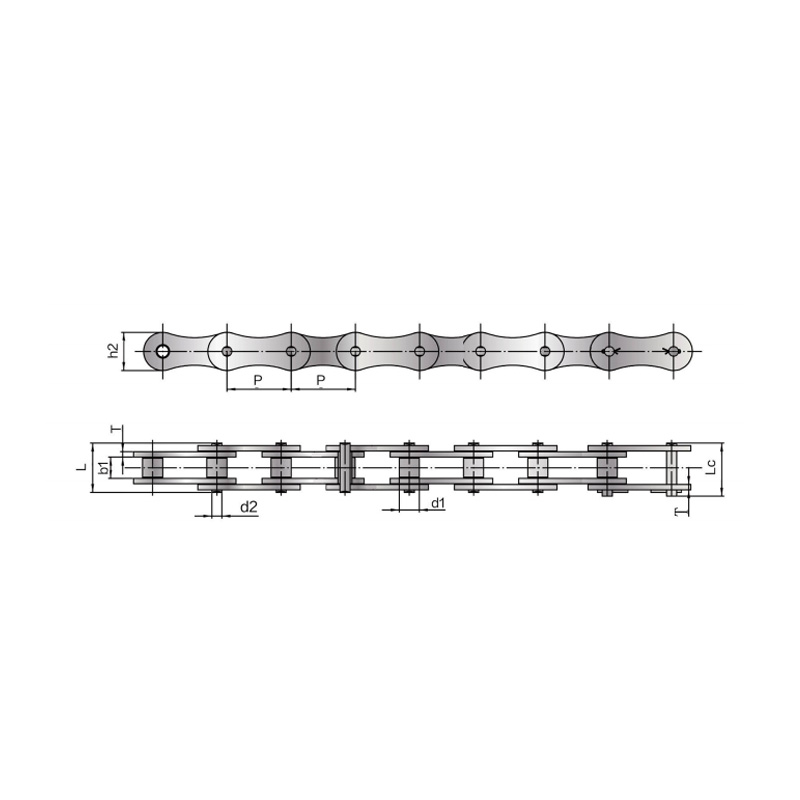
The double pitch driving chain complies with various international standards. The pitch of the doubl...
See Details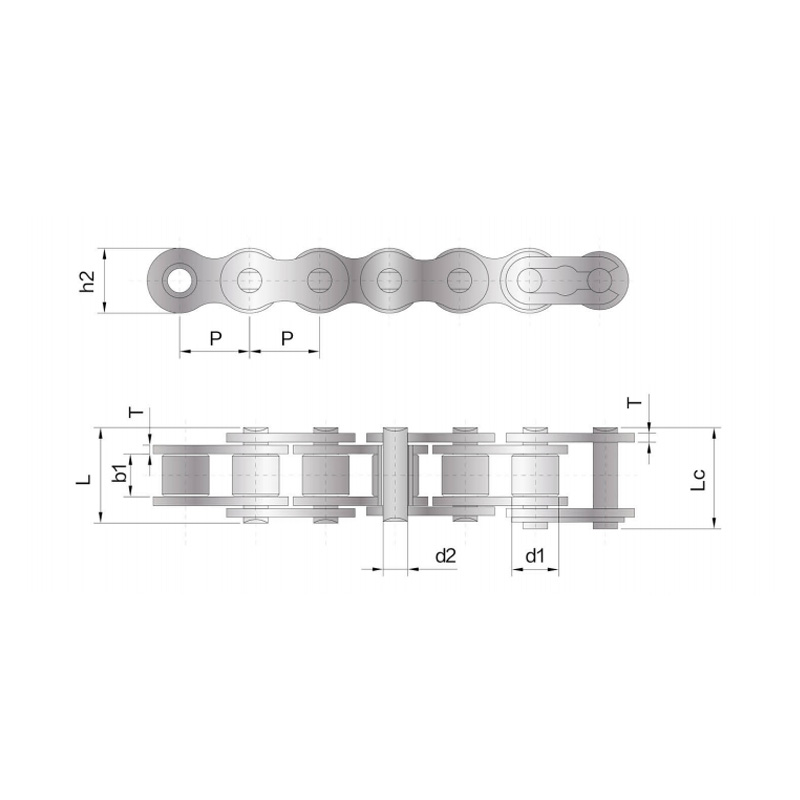
We also produce single row roller drive chains in more sizes and varieties. Customised products, sui...
See Details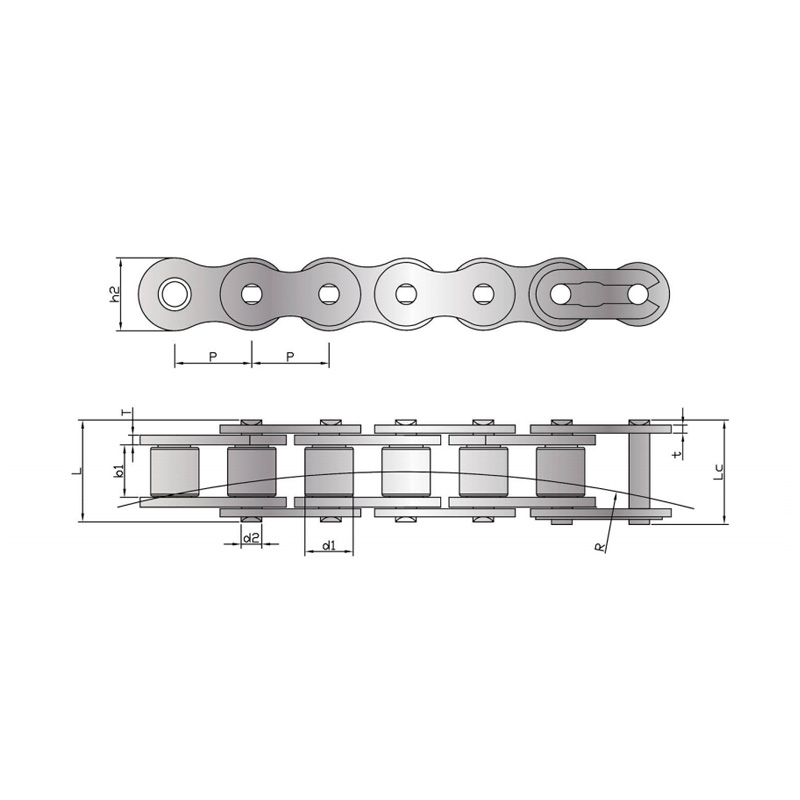
Side bow chain refers to changing the size of parts in the design of short-pitch precision roller ch...
See Details
The Anti-Sidebow chain for pushing window is a functional product with specially designed parts and ...
See Details
The A series short-pitch straight plate precision roller chain has a smaller pitch, a relatively lar...
See Details© Suzhou Fubang Machinery Chain Transmission Manufacturing Co., Ltd. Stainless Steel Roller Chains Manufacturers Conveyor Chains Suppliers
